
A Joyagoo shipping calculator answers a question about a parcel with specified inputs. Before comparing results, check whether the dimensions are packed measurements, which divisor applies and what the service does with actual and volumetric weight. The arithmetic cannot fill in unknown route conditions by itself.
Identify the formula and units
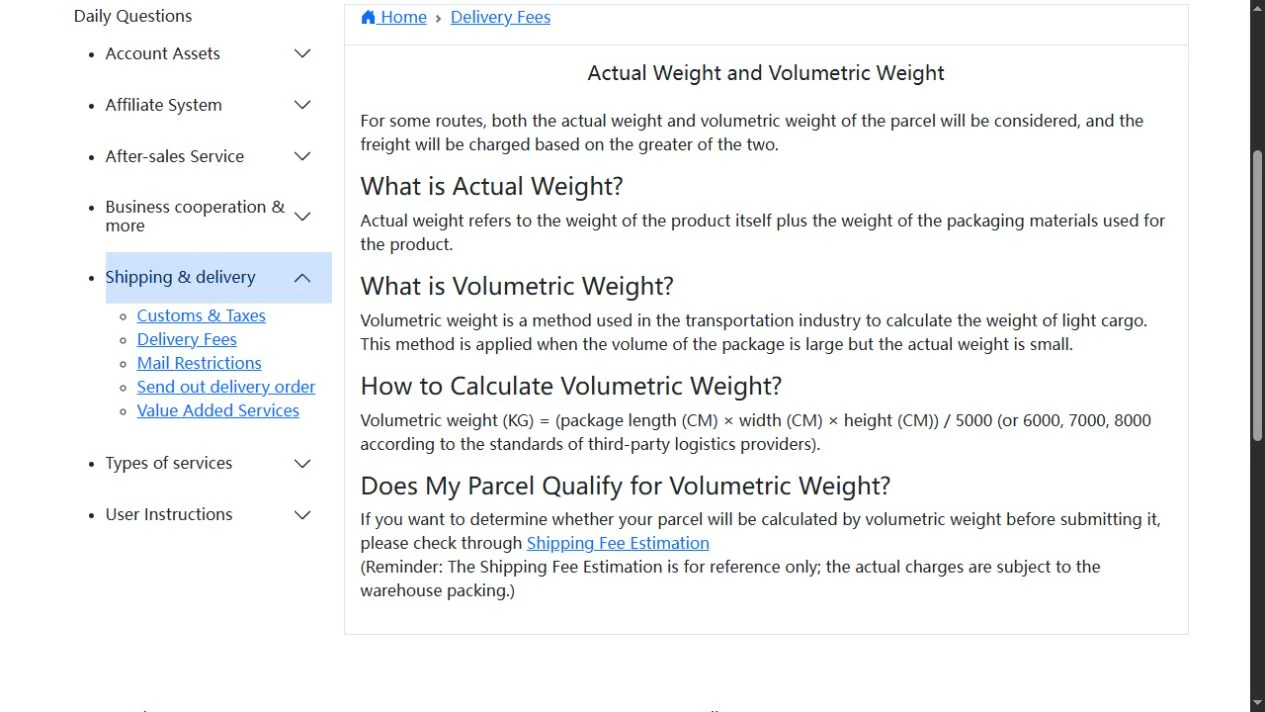
Joyagoo's checked explanation multiplies parcel length, width and height in centimetres, then divides by the applicable logistics-provider divisor. Different services may use different divisors. Some compare the volumetric result with actual weight and charge according to the greater figure.
Keep that weight comparison separate from currency pricing. It does not establish the fee per kilogram, rounding rules, minimums or all additional charges for a particular line.
Work through an explicit example
Consider a hypothetical 42 × 30 × 20 cm parcel with an example actual weight of 3.0 kg. Its volume is 25,200 cubic centimetres. Dividing by an illustrative 6,000 gives 4.2 kg of volumetric weight.
For a service using the greater value under those assumptions, 4.2 kg is larger than 3.0 kg before any other applicable calculation. These inputs are not a real customer's parcel, and the divisor is not asserted to apply to every available route.
Test a packing change
If the height in the same example becomes 16 cm while length and width stay fixed, volume becomes 20,160 cubic centimetres. At the same illustrative divisor, the result is 3.36 kg. This demonstrates the effect of a dimension change, not a verified monetary saving.
Ask whether the proposed smaller package still protects the products. Removing packaging solely to reduce a number can be a poor choice if the goods need that protection. A different packing request should be treated as a different estimate with its assumptions visible.
Decide what needs updating
Recalculate when contents, packed dimensions, weight, destination or service change. Keep the currency and included services with the quote rather than comparing two isolated totals. If a measurement is unknown, label it as a planning input rather than presenting it as warehouse-confirmed.
Use shipping guidance for eligibility and destination questions and warehouse planning before submitting the parcel. Adding another the catalog find is a reason to review the basket, not evidence that it fits the previous calculation unchanged.